A golf ball marker is the smallest thing you will ever put a logo on, which is exactly why it is easy to get wrong. Order it a few millimeters too big and it breaks the Rules of Golf; pick the wrong attachment and it never leaves the pro shop drawer; choose the wrong finish and the color chips off within a season. This walkthrough takes the decision in the order a decorator actually needs it, so the spec you hand over produces a marker players keep on their hat.
Start with the size the rules allow
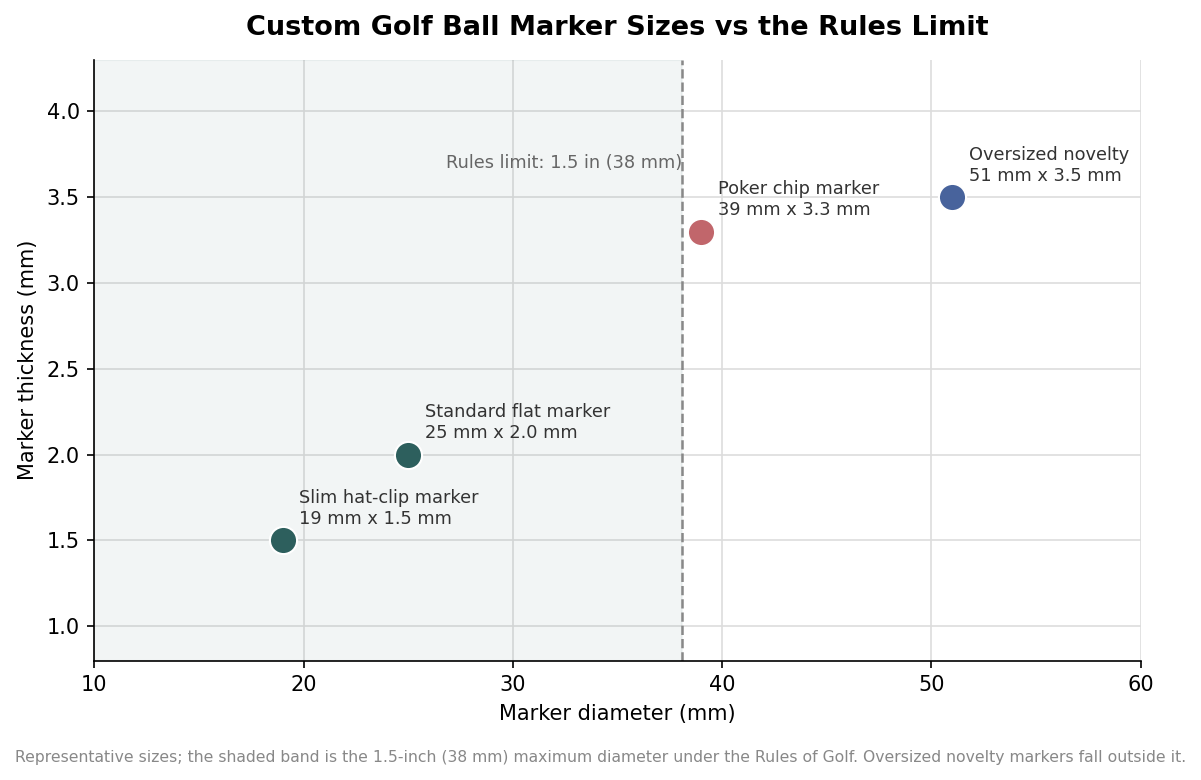
Size is the one spec with an outside referee. Under the Rules of Golf a ball marker is meant to be a small artificial object, and the practical ceiling the industry works to is about 1.5 inches, or roughly 38 millimeters, in diameter. The moment a marker carries an alignment aid, a printed line to help square a putt, the limits tighten: it has to stay under one inch in height and under two inches in any horizontal direction, or it is classified as an alignment device and cannot be used while you play a stroke. That distinction catches buyers off guard when they add a “handy” aiming line to an oversized design.
In practice, standard flat markers run about one inch, or 25 millimeters. Slim markers made to sit in a hat clip are closer to three-quarters of an inch, around 19 millimeters. Casino-style poker chip markers sit right at the 1.5-inch line, which is why they are legal for play but leave no room to grow. Anything larger is a novelty piece: fine in a gift box, but not something a serious player will use on the green.
Choose the attachment before the artwork
The attachment decides how the marker is carried and how strong the magnet has to be. A magnetic hat clip is the everyday default and the easiest gift to hand out at a league night. A divot-tool combo, where the marker pops out of a magnetic slot, reads as course merchandise and justifies a higher price. A poker chip holds a small removable magnetic marker inside a larger chip, which suits tournaments and casino-night charity events. Money clips and bag tags move the marker into the premium-gift and sponsor category.
Pick this first because it constrains everything downstream. Hat clips and divot tools want a marker of about one inch or smaller, and they need a magnet strong enough to hold through a cap brim yet release cleanly. A poker chip lets you run a larger, more detailed chip face while keeping the actual marker small enough to be legal.
Presentation is part of the attachment decision, not a separate line item. A marker handed out in a plain poly bag reads as a giveaway; the same marker on a printed header card, in a velvet pouch, or clipped to a branded divot tool reads as a gift worth keeping. If the markers back a sponsorship or a member appreciation event, budget for that packaging up front, because it changes how the piece is received far more than an extra plating upgrade does.
Pick the metal, finish, and plating
Finish is where durability and color range trade off. A die struck marker stamps the logo in relief into brass or iron and then plates it, with no added color; it is the most durable and the most premium-looking, but limited to metal tones. Soft enamel fills those struck recesses with color, leaving a surface you can feel with a fingernail; it offers the brightest color range and the best value. Hard enamel, sometimes sold as imitation cloisonne, is polished flat and is tougher and more jewelry-like, at a higher cost. Offset-printed markers put full-color or photographic artwork under a clear epoxy dome, which is the only way to reproduce gradients and photos, though the dome can scuff over years of pocket wear.
Plating rounds out the look: shiny nickel or silver, polished gold, black nickel, and antique bronze are the common choices. Match the finish to how the marker will live. Outdoor daily use rewards die struck or hard enamel, while a detailed multicolor crest or a sponsor photo belongs under an offset dome.
Set quantity, thickness, and lead time
Quantity moves the unit price more than any other lever. Setup and tooling are spread across the run, so a larger order generally lowers the price per marker, while very small runs carry a higher cost per piece. At Get Custom Golf Ball Markers the minimum order is 12 markers per format. Thickness is a smaller decision with a real feel: flat markers are commonly 1.2 to 2 millimeters, while a poker chip is around 3.3 millimeters. Thicker reads as premium but adds weight and cost. For hat-clip use, specify a neodymium magnet so the hold survives a windy round.
Build in time. Standard production at Get Custom Golf Ball Markers is about 2 weeks after you approve your proof, and express shipping is available when an event date is close. If the markers are tied to a tournament or an outing date, add a buffer and confirm your proof early, because a reprint erases the whole schedule.
Put the whole spec on one line
A clean spec prevents a slow quote. Reduce every decision above to a single sentence a decorator can act on, for example: one-inch (25 millimeter) round, two-millimeter zinc alloy, soft enamel, shiny gold plating, magnetic, packaged with a black hat clip, 250 pieces. Then ask for a pre-production sample before the full run, and if the marker will see tournament play, confirm that it, and any alignment line, stays inside the size limits. Get those three things right, the size, the attachment, and the finish, and the artwork is the easy part.